A bad survey from FCPS
Fairfax County Public Schools (FCPS) has a calendar problem. We’ve bloated up the school year with holidays, extended breaks, teacher work days, elementary school half-days, and confusing “religious and cultural observance days”, where school is in session but classroom activities are limited in various ways.
The sum total of all this is an absurdly small number of five-days school weeks, and an even smaller number of actual five-days-of-learning weeks, all despite a school year that runs from mid-August to mid-June, making for a very short summer. It’s a mess.
More or less everyone seems annoyed by this. But there’s little consensus on how to fix it. Should we shorten the current two-week winter break? Eliminate/shorten Spring Break? Reduce the number of religious holidays? Stop observing all the federal holidays? Kill the elementary half-days? Chuck the cultural observance days? Dump the teacher work days?
In April, the school board voted to have school on Veterans Day, and to limit the elementary school half-days to eight(!), while also rejecting a proposal to go to school on Indigenous People’s Day (aka Columbus Day). That’s a start, but a far cry from actually getting anywhere.
FCPS has put out a survey to gauge public opinion, as they work through more changes to the 2026-2027 calendar. In theory, this is a good thing. Parent input isn’t always ideal in education, but this is a highly useful and appropriate spot for it. And even if it’s not a scientific measure of public opinion, there’s still value in the results—any bias in response rates will reflect people who feel strongly about the issue, and there’s nothing wrong with taking intensity of preference into account in this sort of thing.
The survey, however, isn’t great. This question in particular seems really bad. It asks a good question—if we are going to shorten the school year, how should we do it?—but the choices given are riddled with problems:
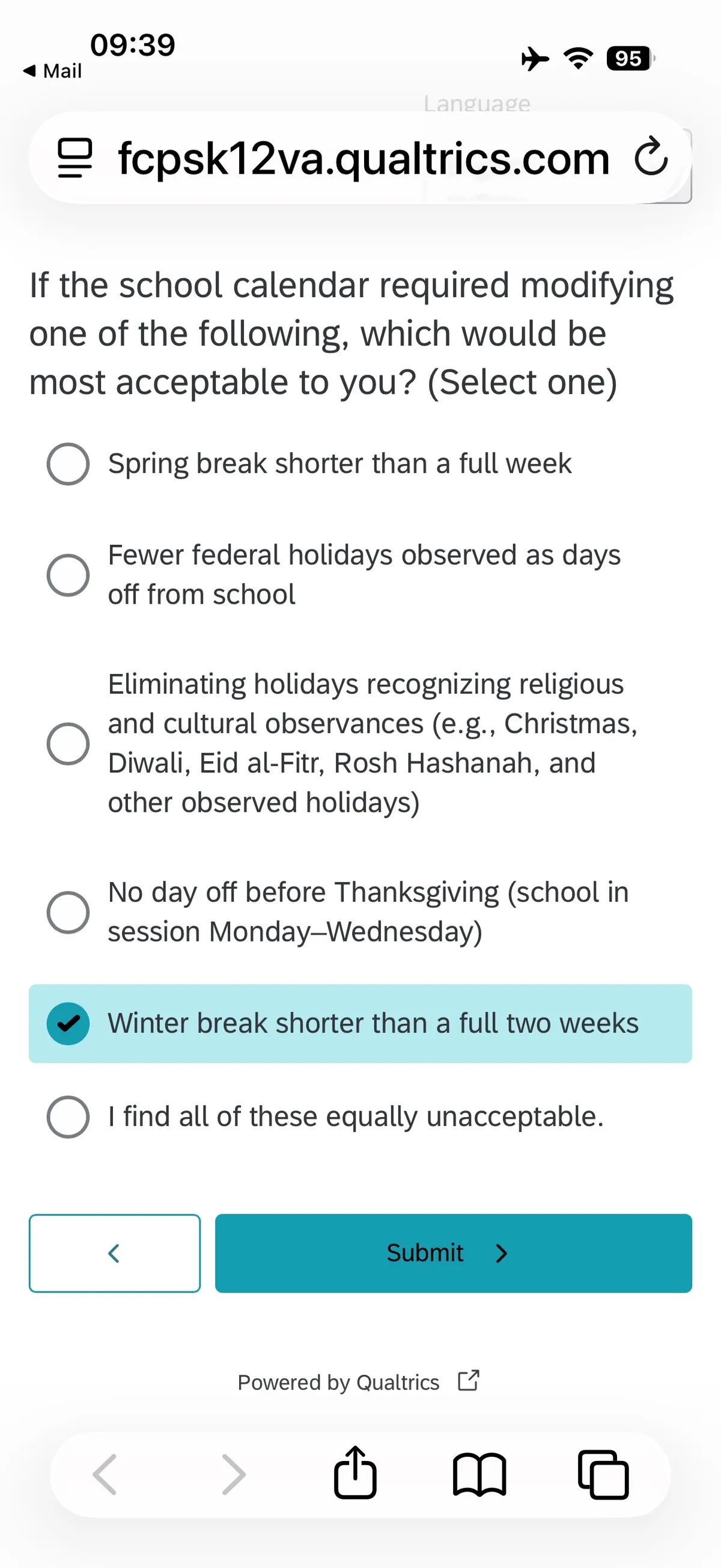
Start with “Fewer federal holidays.” That isn’t a policy; there are some federal holidays we simply aren’t going to cancel (Christmas, Thanksgiving, Memorial Day, New Year’s Day), some that either aren’t during the current school year or fall during other breaks (Independence Day, Juneteenth, Christmas, New Year’s), one that has already been cancelled (Veterans Day) and some that are clearly on the potential chopping block (MLK Jr. Day, Washington’s Birthday, Labor Day, Columbus Day). Those should be named, so that survey respondent know what’s actually at stake.
Even worse, the “eliminating holidays recognizing religious and cultural observances” starts with the absurd example of Christmas. This seems obviously designed to dissuade people from picking this option. There’s literally zero chance Christmas goes away as a school holiday, what could possibly be the purpose of including it on the list except to scare people off the choice? Again, name the holidays that are actually on the chopping block.
Finally, the survey also leaves off what are likely two very popular options: eliminating some or all of the eight “teacher work day” student holidays (and/or the four staff development / school development days) and pairing back the religious and cultural observances days that aren’t holidays but feature reduced instruction.
The result is a survey seemingly designed to get a particular result—shortening winter break and perhaps spring break, but leave the teacher and religious days alone. Maybe that’s good policy! I certainly think that’s the easiest way to pick up the most days. But the overall feel of the question gives the vibe that the survey is less about getting actual public feedback, and more about shaping a result that can be used to justify a pre-existing idea.
And look, this isn’t a direct democracy and I’m glad it’s not. Elected officials should use their judgement and only selectively take public opinion into account. But that still means designing useful surveys, to properly gauge opinion. This survey almost certainly doesn’t accomplish that.