A Bigger House? Not a Fan
Many people, understandably frustrated with Congress, think a way to improve the place would be to increase the size of the House. Here's Chuck Todd arguing for it today on Twitter:
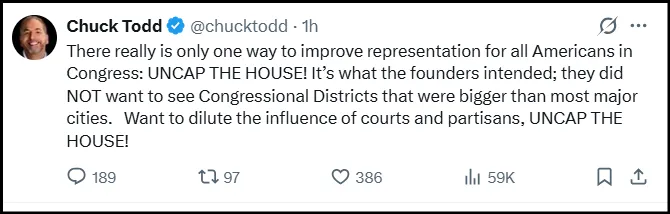
I'm very skeptical. There are good reasons to maybe expand the House a few dozen seats, but the calls to add hundreds of seats or double it seem very much misguided to me.
- It's absolutely true that the House districts have grown in population. The House has not been expanded from 435 Members since the Reapportionment Act of 1911 set the House at 433 seats, plus a seat for the potential incoming states of Arizona and New Mexico.1 This has increased the federal ratio of representation (FRR)---the total U.S. population / number of House seats--- from under 210k in 1910 to nearing 760k today. Good CRS report here.
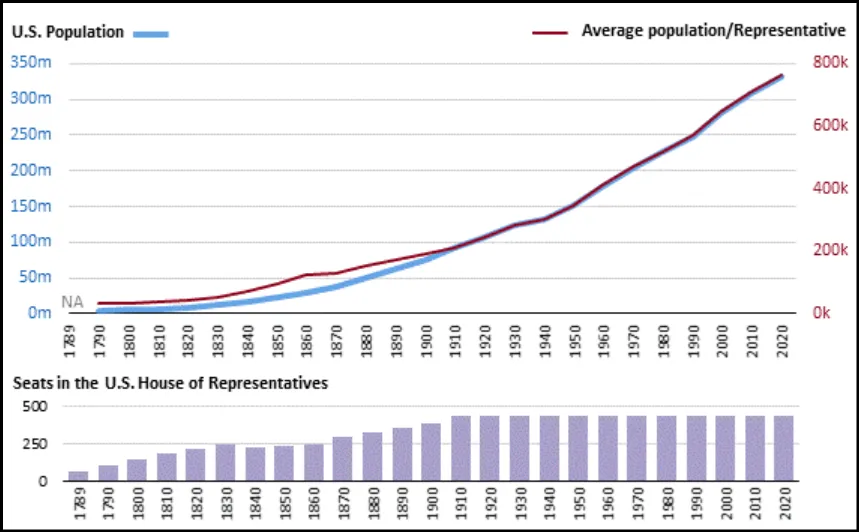
Always get your data from CRS
It's also true that the U.S. is pretty far off in House size under the cube-root law, which states that the size of the lower house of legislature is normally about the cube root of the population being represented. Under the cube root law, the U.S. House would be 692 Members.
Like Todd and others who have argued for a bigger House, the case usually boils down to four arguments: the intent of the Framers for small districts, better representation with fewer constituents, more electoral competition in small districts, and less partisanship in small districts.
None of these arguments make much sense to me.
The Framers intent here is largely irrelevant, and should be ignored. They just had no idea what was coming, and the idea of a nation of 330 million people would have been pure science fiction to them. Sometimes people point to the 30,000 constituent minimum they put in the Constitution, but that highlights the folly of leaning on their 18th century view: no one thinks an 11,000 member House would make any sense.
Not to put too fine a point of on it, but contra Todd, the Framers did intend the districts to be size of our biggest cities. Their 30,000 number put the minimum district size in line with the 1790 population of New York (33k) and Philadelphia (29k), our two biggest cities. It dwarfed the next two biggest, Boston (18k) and Charleston (16k). This is not an argument for million person districts; it's just more evidence that we should disconnect our assessment from the Framers on this issue; they were living in a wholly different time and place.
The representation question is mostly just a math problem. People will tell you that representatives used to know their districts better. But they never try to pencil out the numbers. Almost nobody is talking about increasing the House to more than roughly 600 Members. But that ends the possibility of much representational benefit right there. Even doubling the size of the House (to 870) still leaves you with 400k districts, roughly where we were in 1950. To get back to the 1910 FRR, we'd need 1578 seats. And even that is arguably too large for a representative to actually know their constituents.
And this gets at the fact the House-expanders never want to face: there's a House size that's just unwieldy in an absolute sense. The representation issue doesn't just operate at the district-size level. It also operates at the chamber-size level. Small-group decision-making is different than large-group decision-making. That's obvious to anyone who's deliberated with 12 people and 50 people. But you can see this in the Senate, compared to the House; the Senate is a small enough body that every Senator can plausibly have a personal relationship with every other Senator, or at least all the Senators in their party. Not possible in the House, even at the current size. Double it again and it's not clear you could even have a meaningful party-meeting in HC-5. At some number, it ceases to function as a representative parliament and begins to looks more like plebiscitary politics. Which sucks.
The electoral competitiveness argument never made any sense to me. That's not a function of district size. If anything, it's the opposite; small districts put through the gerrymandering wringer are likely to produce more lopsided, one-party seats, not fewer.
And that goes to the partisanship question. Smaller constituencies are more likely, on average, to produce radical Members. The districts will be less diverse across any number of dimensions. You think you have a lot of kooks in the House now? I promise you, the circus in an 800 Member House would need more than three rings.
Now, onto the downsides. Most importantly, I have no earthly idea what all these Members would do all day. The House is a highly centralized legislature right now. Maybe three dozens Members have 95% of the power. Adding more Members would only exacerbate that. Their basic vote would be diluted, as would their voice. They'd have basically no chance to ever speak on the House floor, let alone offer an amendment. Committees wouldn't be much better. And their political standing would be more precarious than now, forcing them to stay tightly aligned to the party. They'd have almost no opportunity to legislate; they'd barely be in any of the meetings. They'd be party soldiers.2
As a consequence, the quality of the Members will surely decline. Less opportunities to actually make policy, combined with a greater necessity to support the party, and you've got a recipe for a level of hack Member that I'm not sure people are prepared for. And with nothing to do, it's easy to imagine the scandals proliferating.
As Huzzah points out, it's not like small-d democratic quality springs from small district size. How much do you know about your state legislators or what they are up to, relative to your US Senators?
Finally, no one is going to want to pay for this. And it's not going to be cheap. I've written about this in detail before, but we're talking billions of dollars to do this, since you are going to need another House Office Building. And look, I'm all for spending more money on Congress, but the sad truth is that voters hate it and it's basically impossible to get the Members to vote for big increases to the budget for the legislative branch. The average voter is going to look at the price tag and want to throw all the current Members to the curb.
This does not include the temporary increase in 1959 for Alaska and Hawaii, which were each given 1 Representative, brining the House to 437 until the full reapportionment after the 1960 census, when it was brought back to 435. Also note that the Permanent Reapportionment Act of 1929 locked in the 435 number such that future apportionments would be done automatically with the 435 number, rather than Congress necessarily considering it after each census.↩
If you want to decentralize the House, you have to decentralize the House. That is, give meaningful power back to the committee chairs. This would give backbench Members more opportunities to meaningfully legislate, rather than just vote. But that's true at 435 as much as it is at 1000.↩