Anatomy of a letter
Last Wednesday, Senate Democratic Leader Chuck Schumer and House Democratic Leader Hakeem Jeffries sent a letter to their Republican counterparts, outlining their demands for ICE/CBP reforms in the negotiations over funding the Department of Homeland Security, for which current funding expires this Friday.
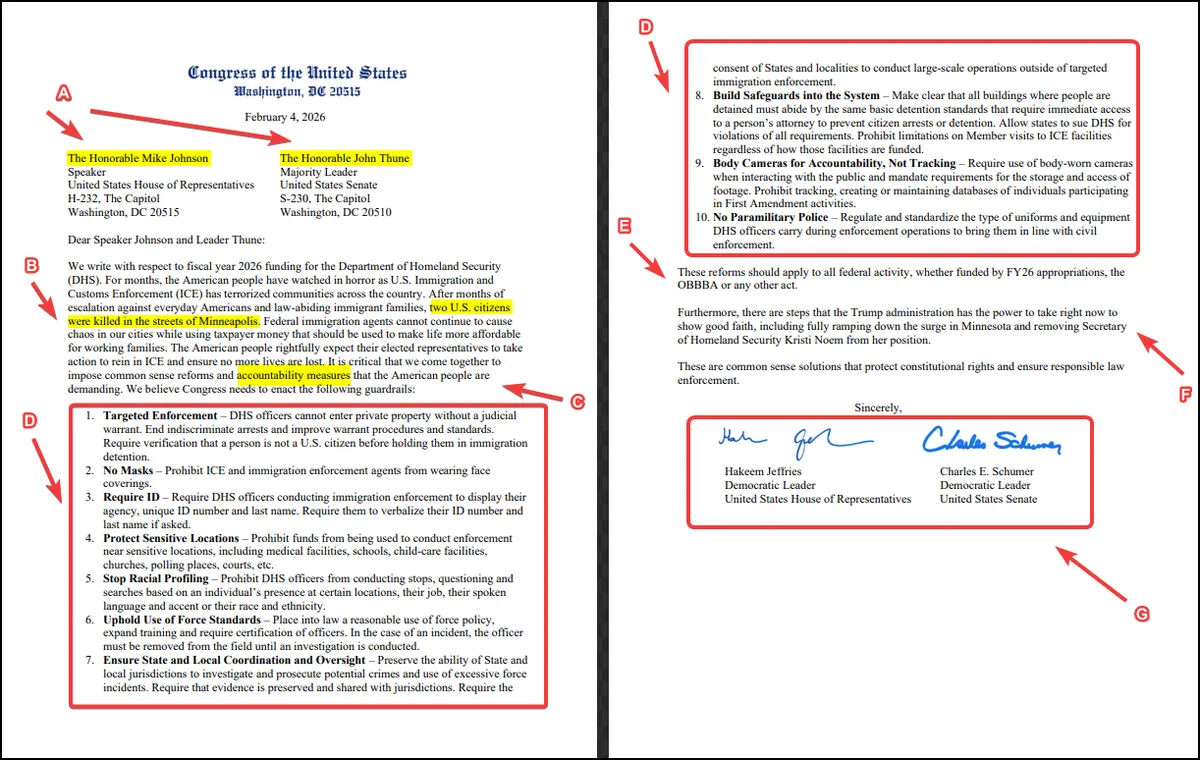
Some political notes on the letter, corresponding to highlighted portions of the document:
A. It's a letter ostensibly being sent to congressional leaders who are the counterparty in negotiations over the DHS FY2026 funding bill. But more importantly, it's a public letter. Congressional leaders don't need to reach each other through the mail, or via memo. The primary audience for this letter is the public. As such, you can think of this as an attempt to shape public narrative rather than a communication to a counterparty.
That said, the letter is not just a press release; it’s also a party platform document. In some sense, the sending of this letter was a deadline event for the House and Senate Democratic caucuses. The leaders would like this to be the talking points that all Democrats use during the public debate on this issue, so that you don't have 20 different positions floating around in public.1
But to get to this point, the leaders had to craft the actual position of the party. That might be a top-down exercise, or a bottom-up one. But to get the letter out, you have to come to a position. To some degree, this letter represents the internal politics of the Democratic Party.
B and C. The framing of the letter. Democrats obviously want to have this political fight be about ICE/CBP abuses, not about immigration per se, and the letter reflects this, focusing on accountability measures that will prevent the deaths of U.S. citizens going forward. This framing choice is also a reflection of party negotiation, and may have included compromises between various factions. On the policy side, the implicit demand is that Congress takes action, rather than relying simply on administration policy changes in the executive branch.
D. The demands. Note that this is an expanded list of demands from previous public statements of Schumer. These are clearly aspirational in nature, and explanatory of the party position on the issue; no one is expecting to get all of these in an actual legislative negotiation. Again, this is a public letter, not a private negotiation offer. And also a compromise party platform document, destined to annoy progressive groups.
E. Scope conditions. I’ve written about this before (see points #20-21 here).
F. The thing to understand here are that these demands for executive action are things that would be politically impossible (or actually impossible) to do via legislation. That certainly makes them evidence of good faith if the administration were to take them, but it also
G. It's signed by Schumer and Jeffries. This present a united front, which is important both on its own terms in a negotiation, and because Jeffries was clearly miffed that Schumer negotiated the CR deal with the White House and Senate Republicans without brining in the House Dems.
That may or may not succeed. Lots of different Representatives and Senators will have their own opinions and be more than willing to share them.↩