Congressional Approval
Congressional approval stands at 10% in the monthly Gallup poll, just one point above it's record low.
- Congress has never fared well in the Gallup poll. But since 2007, it has fared even worse than usual. We only have good polling going back to roughly world war II, but we have plenty of anecdotal evidence from the 19th century that Congress was just as unpopular then.
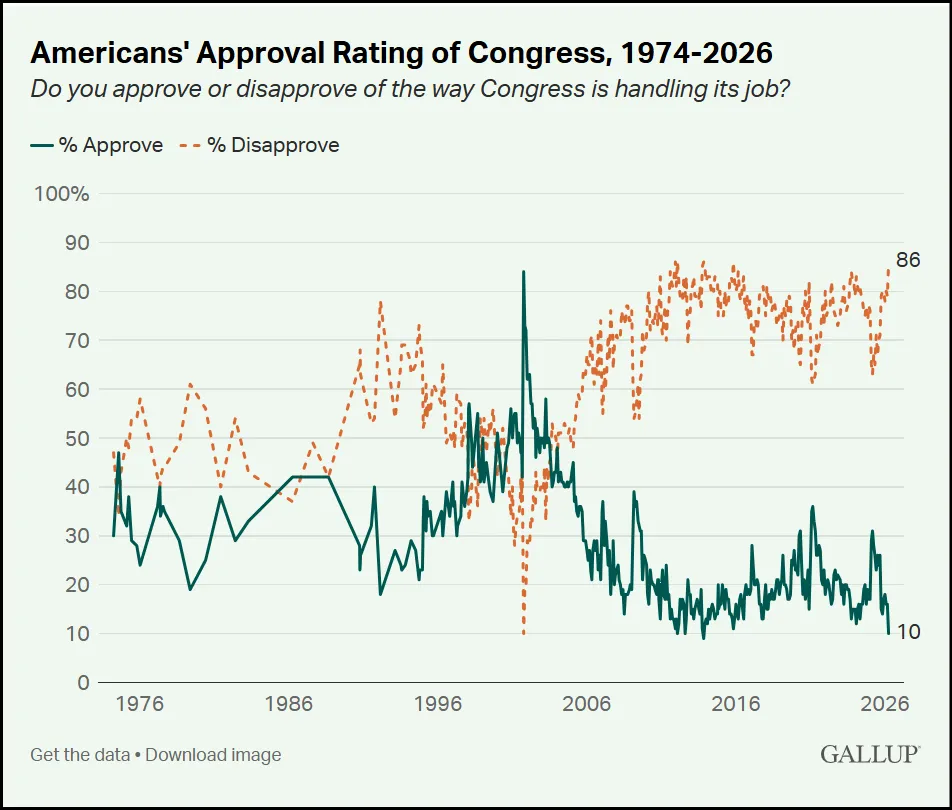
People will give you all sorts of reasons for why they dislike Congress, but in my view, it all reflects one underlying dynamic: people hate Congress because they hate losing. And you are going to do a whole lot of losing in U.S. politics.
You can also replace "Congress" here with "politics." Largely because Congress is the public location of politics in the United States.
The recent drop off of the 119th Congress---from 31% in March, 2025 to 10% now is a story of independents disappearing in 2025 (from 25% in March to 12% in December) and Republicans dropping significantly twice (from 54% to 23% between September-October 2025 and, after rebounding slightly, from 32% to 20% in March-April 2026).
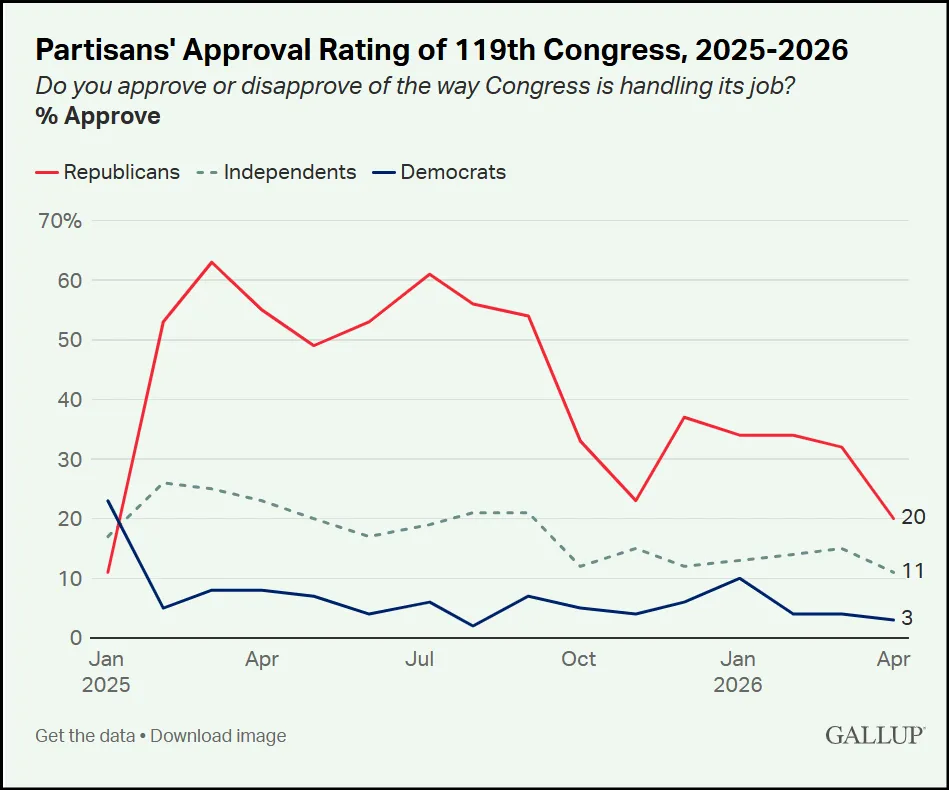
Partisans tend to disapprove of Congress from both ends ideologically, as well as general discontent with non-ideological accomplishment levels.
Unlike support for Trump, there isn't a floor for Republican approval of the Republican Congress. This is not unusual.
Fenno's paradox---where Congress is unpopular but individual Members are very popular in their district---is not as strong as it once way. This is mostly the disappearance of the so-called incumbency advantage, in which Members who did a good job for the district got roughly 20% electoral support from people who voted for the other party for president. Those days are gone; the average Member runs about 0.5% to 1.0% ahead of their party's presidential candidate now, down from an average of 10-12% ahead in the 1980s.