How many House Members were born in the state they represent?
Mary Peltola represented Alaska in the House from August 2022 until January 2025. She also happened to have been born in Alaska. This is notable because she was the first person to ever represent Alaska in the House who was born there.
That even includes the period of time (1906-1959) when Alaska was a territory and had a non-voting delegate instead of an actual representative. Eight delegates and four Representatives preceded here, none of whom were born in the state.1
That's certainly unusual. But it got me wondering about other states. So I asked Claude for help.
In about 30 minutes, Claude and I were able to produce results based on the 96% of all Representatives in U.S. history who have complete information on place of birth in easily accessible datasets.2
As it turns out, for all of American history, 59.3% of people who have served as Representatives in the House were born in the state they represented, and 63.6% of all seat-terms in the House were filled by people born in the state they represent.3
Here are the state rankings:
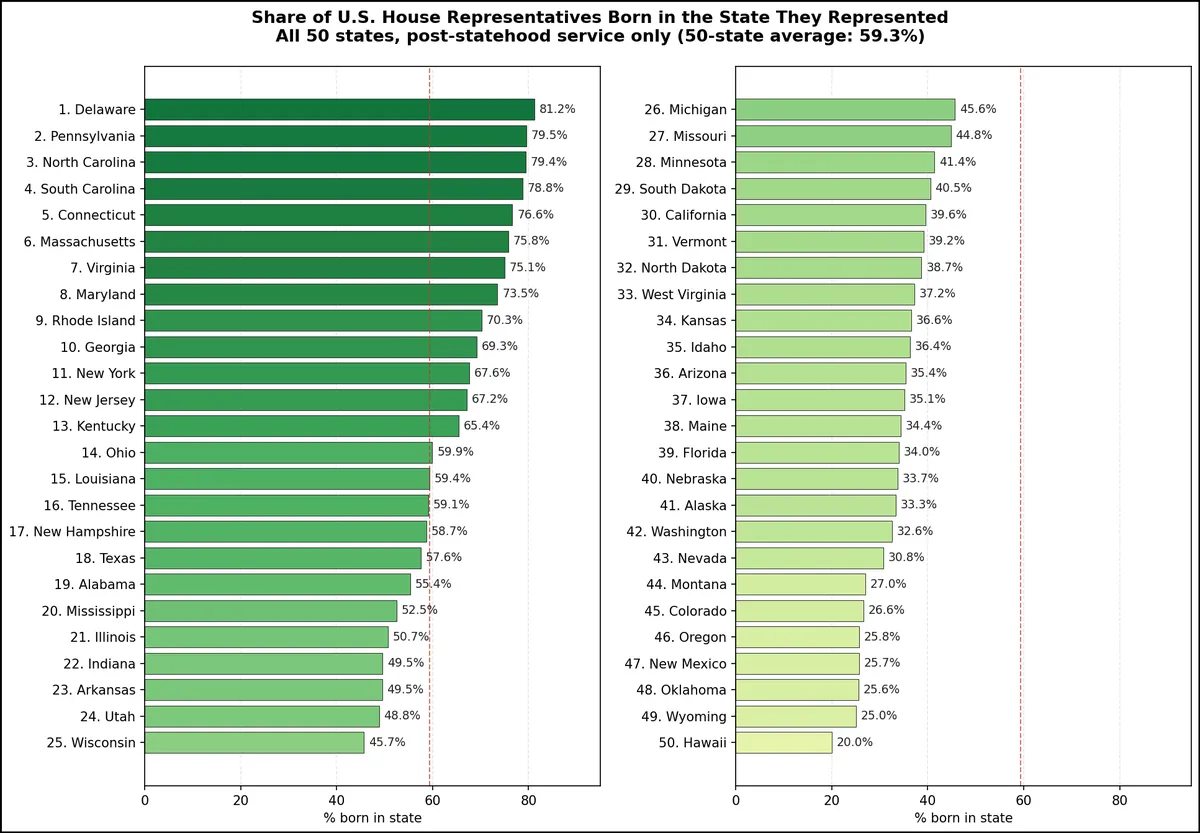
Nothing here seems super surprising. That the older, eastern states have more home-grown representatives than the western states seems exactly in line with expectations; not only do migrations patterns in the U.S. move east to west, but western politics has traditionally been a lot more wide-open than the early-developed machines in the east. Maine and Vermont being so low on the list did catch my eye a bit.
Here's the basic breakdown by era:
- 18th century (1789-1800): 72.1% (n=575 seat-terms)
- 19th century (1801-1899): 53.6% (n=12,201)
- 20th century (1901-1999): 68.8% (n=21,726)
- 21st century (2001-present): 64.0% (n=5,673)
For the record, in the 119th Congress, it's 64.1%.
So there you go.
Some notes:
This is a project that goes from a huge is-it-worth-it debate to a pretty simple 20 minute task with the help of an LLM like Claude. I was impressed. I'm not scared of programming, but I'm not any good at it. Claude located and downloaded the necessary data, wrote a Python script to extract and compile the actual dataset we wanted, walked me through executing the script, and then analyzed the results. I'm sure I could have automated this further in Claude Code or whatever, but I just did it in the Chat interface. It was a snap.
I have not checked the results in detail. I did hand check the Alaska results to confirm that it got 2/14 delegates/representatives born in the state, which it did. That's obviously a problem with lightning-fast LLM data analysis like this. If this were more than a curiosity blog-post, I would likely go into the data and do a lot more checks. But I suspect there will be a lot of dispensing with that going forward.
UPDATE: Cleaned up some data on delegates being counted in the denominator, slightly changed some of the numbers.
Current Alaska Representative Nick Begich III, who succeeded Peltola in the House, was also born in Alaska.↩
This is a rough-and-tumble analysis. It excludes 4.4% of Members due to unknown places of birth. So there are 10,995 person-state pairs, but 493 unknowns. Source data: @unitedstates/congress-legislators (House members 1789-present, n=11,462 unique people) + Wikidata SPARQL for birthplaces.↩
It turns out, there are some interesting methodological choices in the analysis. Do you use seat-terms or person-state pairs? [I used the former for eras, the latter for state rankings]. Do you count the delegates? [I did]. What do you do with people born prior to the state they represent existing? [I counted them as no, even if they were born in the territory, which was rare. But I did the opposite with the colonies; so if you were born in Virginia colony in 1750, you count if you represent Virginia. Also, the territories don't line up well with the future states; Michigan territory contains six future states, so it's not clear what "born in the territory" even means]. There are also many edge cases, like people born in what is now Maine but was then Massachusetts.↩