Partisan stag hunts, everywhere
I'm seeing a lot of political actors and commentators advocating for hardball strategies right now, while lamenting that what they are advocating for isn't ideal.
Here's Senator Ron Johnson (R-WI), on why Republicans need to nuke the filibuster to pass the SAVE Act:
"I completely understand my colleagues who want to maintain the filibuster. We all want to maintain the filibuster, honestly,” Sen. Ron Johnson (R-Wis.) said. "But I know the Democrats won’t. That’s the only division here.”
“When the Democrats have the chance, they will end the filibuster. They want to turn America into a one-party nation – pack the Supreme Court, turn D.C. and Puerto Rico into states,” Johnson told Fox News on Monday. “So we need to stop them, and the only way we can stop them is to end the filibuster now, pass election integrity reforms, so that only American citizens can vote.”
He added, “I’m just being practical. They’re going to do it. We ought to do it before that for the benefit of the American people.”
Here's Jonathan Bernstein, advocated Democratic court packing:
The first and probably best option is to “pack” it. In other words: Add more Justices...[a]ll it would take to add another one or two or ten Justices would be Congress passing something and the president signing it. Then nominate and confirm the new Justices, and the GOP majority on the Court is gone.
The downside of court-packing is that it creates an obvious arms race: Republicans would retaliate as soon as they had the chance by doing the exact same thing. As time passes, the Court would become unwieldy, and it’s reputation as simply a partisan superlegislature would grow as well. That’s better for Democrats than just accepting the current partisan superlegislature! But it’s not great.
Look: I don’t like any of this. I’d rather leave the Court alone or perhaps make consensus reforms such as the proposed 18-year staggered terms.
Here's Nate Silver, expressing more or less everyone's view of mid-decade redistricting:
Personally, I think having fewer competitive seats and less representative districts is pernicious to representative government. But I don’t think something like Virginia is a particularly close call...It’s completely obvious that you can’t have unilateral disarmament...
All of this is fully rational. In fact, it's an unusually clear example of game theory in action in politics. Even if you like the filibuster, don't want to pack the Court, or prefer not to have gerrymandered House districts, you still have to do it. Or you'll get screwed.
You are forced to make a move that leads to a worse equilibrium that where you started, because not making that move lets your opponent dominate you and gets you a terrible outcome.
Silver describes gerrymandering as a prisoner's dilemma, but I think it actually looks more like a stag hunt, and court-packing and filibuster nuking look like offshoots of the Stag Hunt, including the repeated stag hunt (court packing) and the centipede game (filibuster nuking).
The classic prisoner's dilemma is structured like this: you and a friend are separated for questioning. Each of you can confess or not. If neither of you you confess, you both get a month in jail on lesser charges. If one of you confesses and the other doesn't, the confessor goes free and the person who didn't gets two years in jail. If you both confess, you both get a year in jail.
Here's a visual version:
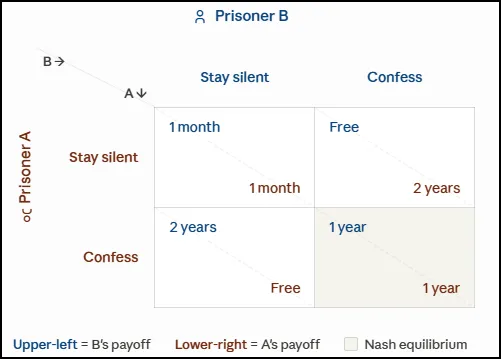
In the prisoner's dilemma, you always defect, because that is the better move regardless of what your opponent does. Look at it from Prisoner A's point of view. If Prisoner B stays silent, A either gets 1 month in jail if he stays silent, or goes free if he confesses. If Prisoner B confesses, A either gets 2 years in jail if he stays silent, or 1 year if he confesses. In all cases, regardless of what B does, A is better off confessing.
The stag hunt is slightly different. The canonical setup is two hunters heading into the woods, where there are known to be a stag and two hares. Each hunter chooses to hunt stag or captures hares. If both choose stag, their cooperation leads to a kill, and the each get half a stag, the best outcome. If they both choose hares, they can each get one on their own, the second best outcome. The worst outcome is if you choose stag and the other hunter chooses hare. In that case, they get two hares, but you get nothing, because you can't catch a stag on your own.
Here's the visual display:
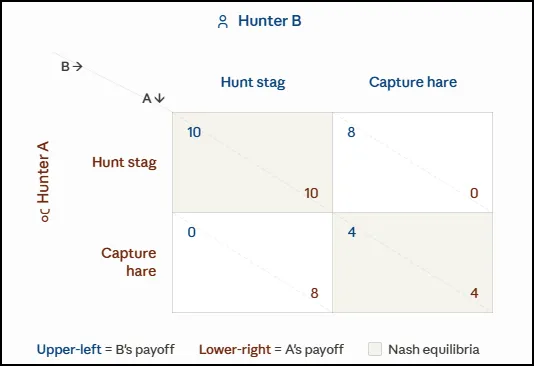
Notice that in the stag hunt, you do not have a dominant strategy of always defecting and going after hare. If you know the other player is going after stag, your best strategy is to join them. But if can't trust the other hunter to not defect, your best option is to defect, take the worse outcome of getting a hare, but avoid getting nothing. The game has two equilibriums; if there's enough trust, no one has any incentive to not hunt stag. If there's not enough trust, no one has any incentive to not capture hare.
This is what is going on all over partisan politics right now. Especially in the case of gerrymandering. People are capturing hares and avoiding getting nothing, because they can't trust the other side not to defect from the stag hunt. Court packing and filibuster nuking are slightly different, since both sides don't make choices at the same time. But the trust problem remains the same.
And the hare equilibrium is absolutely inferior. In the case of gerrymandering, it's value approaches zero; once both sides maximize their gerrymander, it mostly cancels out and you aren't any better off in terms of partisan seats in Congress. But you make the quality of representation worse and fuel partisan anger, and you avoid the other side getting a seat advantage from it.
The way out of this isn't too complicated, but it also isn't easy. You need a trust mechanism, that ensures no one will defect and everyone will hunt stag. On gerrymandering, that could be national legislation that overrides the lack of trust in the states.
Court packing resembles a repeated stag hunt; every time you control the government, you can choose to hunt stag (leave the court as is) or pack the court (capture hares). We are in the good equilibrium now; neither side is defecting. As Bernstein notes, however, as soon as you defect once and capture hares, it's going to hares all the way down, with both sides potentially repacking the court ad nauseum in an arms race.
Blowing up the filibuster is more closely related to the centipede game, since it's a one-and-done shot. The equilibrium of centipede is to move immediately, so that you can get the first benefit before the new equilibrium sets in. Why has this not happened with the filibuster? One game theory answer is that the veil of ignorance over who controls Congress next incentives conservative thinking about reform. But increasing distrust can overcome that, as can a belief that the other sides actions under the post-nuke equilibrium will be intolerable.
Sound familiar?