Virginia's Proposed Constitutional Amendment
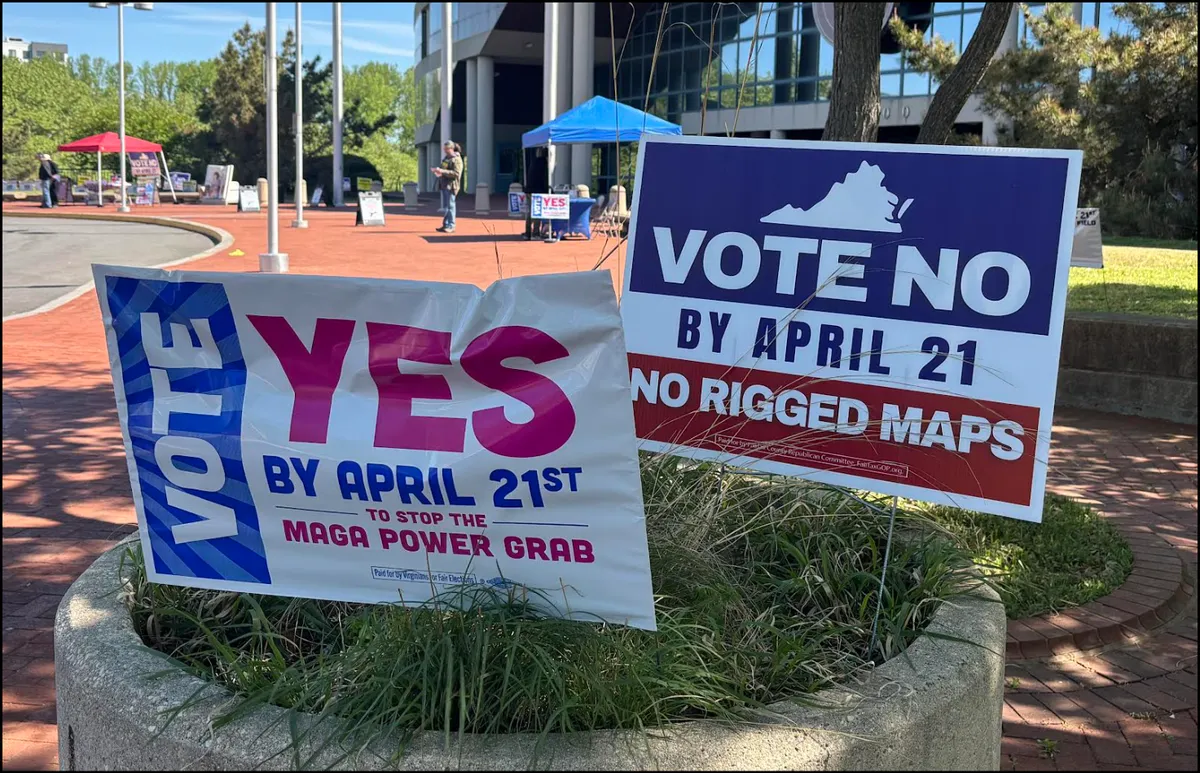
Here's the ballot question we are deciding today in the Old Dominion:
Should the Constitution of Virginia be amended to allow the General Assembly to temporarily adopt new congressional districts to restore fairness in the upcoming elections, while ensuring Virginia's standard redistricting process resumes for all future redistricting after the 2030 census?
Here's a decent non-partisan explainer. Here's my summary: back in 2020, in a 65-35% statewide vote, we took the redistricting of congressional and state legislative districts out of the hands of the normal political process and gave them to an appointed bipartisan commission. The congressional lines aren't scheduled to be redrawn until after the 2030 census, but a bunch of other states are making partisan plays to redraw their lines now, mid-decade. Approving this amendment would authorize the redrawing of lines in Virginia by the normal political process now, but revert us to the bipartisan commission system after 2030. It is transparently a play by the Democrats to increase their gerrymander of the state congressional districts, and it is also obviously a partisan response to what is going on in other states controlled by Republicans, in the sense that Virginia Dems would almost certainly not be doing this if it wasn't going on nationwide.
I voted no. I don't feel super strongly about it, and I honestly wasn't sure how I was going to vote until I got in the booth. I don't really believe in these non-partisan commissions---in general, I think it's better to accept partisanship and try to harness it rather than try to eliminate it---but I like them better than the previous gerrymandering institutional equilibrium. This seems like a big step backwards, for relatively little partisan gain. But again, I don't feel strongly about it and I see the substantive arguments for just doing it.
This is an issue where essentially everyone reverts to a partisan hack---in the classic definition, a political hack is someone who makes arguments they obviously don't actually believe---because it really is a pure question of power and hardball politics, but most people are too proud to admit they just want to screw the other side and increase/guard their own sides' power. So they dress it up in fairness and vote rigging and come up with all sorts of bullshit about who started it and who is cheating. My dad was a font of cynical political realist wisdom, and his take was always "if you are arguing about who started it, there's almost no chance you actually care about who started it, and exactly zero chance that figuring out who started it is your main concern."
I have nothing against hardball politics, per se. I grew up in machine politics and I actually like people who play hardball, don't pretend, and don't apologize for it. But I do think serious constitutional hardball is corrosive to democratic systems, and a lot of our politics does rest on equilibriums that preclude actors from pressing their full advantage, to the maximum, all the time.
Speaking of which, there's an interesting inversion of norms here. We usually talk about political norms as Good Things, but the norm in redistricting politics is to screw the minority. That Virginia broke out of that in 2020 was the end of a norm, and to adopt this amendment would be to revert to the norm.
There's obviously a collective-action problem here, and this may be where I'm most concerned. Because I totally understand the argument that VA Dems shouldn't just unilaterally disarm and let this happen in other states.1 For all the reasons that unilateral disarmament is usually seen as bad. But I'd also note that's also a very nationalized view of Congress, for better or worse. More importantly, solve for the equilibrium: maybe there's some short-term partisan gain here for Dems (or Republicans), but the end result is likely to be a wash in the medium-term, just with congressional districts in all states that further distort representation of the underlying populations.
One concern I have along this line is the problem of state elections becoming pass-throughs for national politics. This is an underrated reason in favor of the 17th amendment (direct election of Senators): state legislative races were ceasing to be about state politics, and instead were proxy elections for the Senate.2 State elections nowadays have already become too much about whether you like Donald Trump or Joe Biden. Making them pass-throughs for mid-decade redrawings of congressional maps seems to exacerbate this.
There's also something icky (to me) about the voters doing this. Like, in my mental model, hardball politics played by representatives and other elite actors feels less problematic than asking the voters to themselves do the fucking. That's probably (definitely?) irrational and maybe just a pure rationalization---I know as a process matter it has to go this way in Virginia---but for whatever reason it doesn't sit (as) well with me.
I suspect the VA amendment will pass and the lines will be redrawn. It won't be the end of the republic, and it won't be huge break from the norms, as noted above.
Someday, we will probably have proportional representation in the states and/or Congress, and all of this will look silly and antiquated.
It's sort of like the electoral college; it might be more fair to assign our electoral votes proportionally rather than winner-take-all, but all that would do is minimize Virginia's impact in the election, since it would almost certainly make our state go 7-6 one way or another. (Of course, in many ways this is different than the electoral college.)↩
Most famously, of course, Lincoln and Douglas weren't actually on the ballot in 1858 in Illinois. They were ultimately just campaigning for their state parties, trying to win control of the Illinois legislature so they would be selected for the Senate. Any voter who picked their state legislators based on the slavery fight and Senate election was essentially choosing national politics over state politics. Which is fine, but problematic for state public policy. And that was over 50 years before the amendment!↩