Vote with your feet, or someone else’s
Relocating to a new legal jurisdictions to alter the government policies that affect you is extremely common behavior. People flee high tax areas. Parents move to better school districts. Thousands of Americans picked up and moved westward in the 19th century in search of opportunity in the territories.
Sometimes the movement is defensive. Refugees come here fleeing oppressive foreign regimes. Mormons set off and created Desert and later Utah to shield themselves from persecution in the east. Celebrities and academics threaten to move to Canada occasionally, and sometimes actually do.
The numerous state and local governments in the U.S. federal system make such voting with your feet options pretty common. Fifty different tax regimes, fifty different business climates, fifty different levels of public spending.
The relative ease of movement to a new state also constrains state and local policy; if you tax too much, people will go. States often compete for emigrants. Florida is very hospitable to retirees; most states trip over themselves to attract businesses via tax incentives; and so on. It can often create a race to the bottom, like when you are desperate to attract Amazon.
What’s less common is purposefully trying to get people to move to a jurisdiction in order to politically change the policies in their new place of residence. It did come up this week on Twitter:
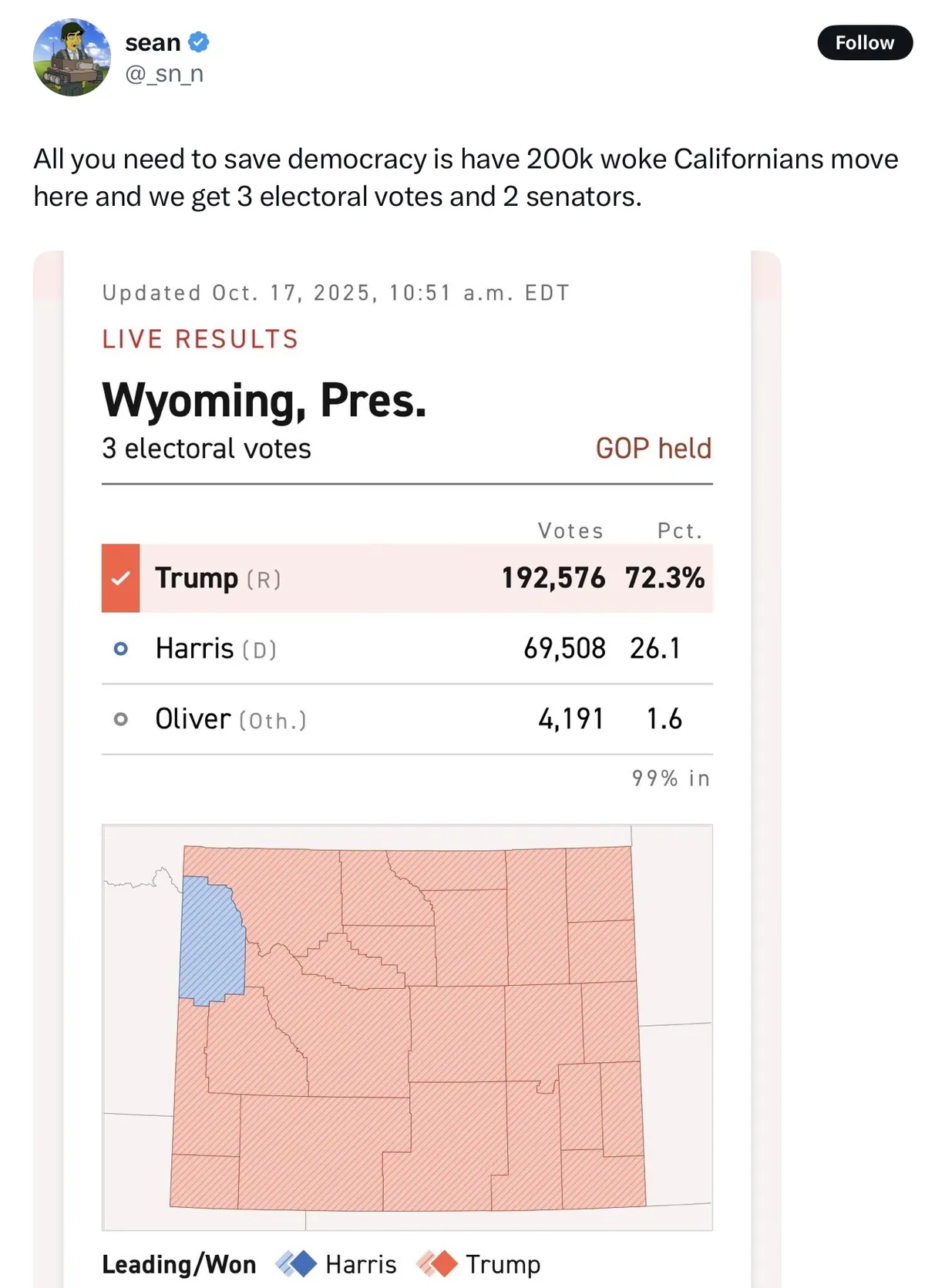
Some notes:
This is a completely legitimate strategy. There’s no way to prohibit inter-state migration in the U.S., or the rights of citizens to be citizens of whatever state they reside in. If Californians want to try to overrun Wyoming and its politics, there’s not much Wyoming could do about it.
The most famous instance of it is almost certainly the paid migration of free-soil northerners to Kansas Territory in the wake of the Kansas-Nebraska Act in 1854. With the Missouri Compromise line effectively replaced by popular sovereignty, both anti-slavery and pro-slavery forces had an incentive to flood Kansas with settlers. So-called Border Ruffians came over from nearby Missouri to bolster the pro-slavery resident numbers. And mutual aid societies in the northeast, most notably the New England Emigrant Aid Company, paid and facilitated the relocation of anti-slavery immigrants to Kansas. It was reasonably successful. Of course, this led directly to armed conflict in Kansas Territory and massive political battles in Congress.
More recently, the Free State Project sought to draw enough libertarian migrants to New Hampshire that they could dominate state politics and reshape policy to their liking. It largely failed.
Note that the mechanics of the California to Wyoming strategy piggy-back on both the federal system, the malapportionment of the Senate, and the excess Democrats in California. It is essentially a national move to more efficiently allocate votes. In a legislature built on national proportional-representation, it would typcially have zero effect. It also means the small states are more vulnerable to this than the medium or big states.
This is much harder in practice than in theory. First, people don’t want to move to Wyoming, for any number of reasons economic, cultural, or practical. So you’ll have to compensate them. But that means getting people to pony up the money. Nobody wants to do that either, at least not at scale. The tweet points out 200k people would do the trick, but even if people all had remote jobs, they probably aren’t going for less than 10k each. That’s $2 billion right there. Assuming no one starts paying red-staters to move there. Good luck.
Consequently, this won’t happen. Anti-slavery relocations to Kansas Territory benefitted from a sizable population of easterners already considering a move out west, relatively appealing economic opportunity in the target jurisdiction, and a specific burning issue about to get a plebiscite in the target jurisdiction, with long-term ramifications. “Go disrupt your life and move to Wyoming so we can get two Senate seats, we’ll find someone to pay for it” just doesn’t compare to “I heard you were thinking about moving out west, these fanatical abolitionists will pay for it if you go to Kansas Territory. You hate slavery, right?” Much easier lift, on the margin.
Note that public policies can also attempt to purposefully create internal political migration. The Homestead Act was famously championed by Republicans in the 1850s, in part, because it would have inevitably incentivized westward movement of anti-slavery free soil northerners. The size of the land giveaways and the terms of settlement essentially foreclosed the possibility of it being used to setup plantations, and the southerners knew that most of the west wasn’t going to be capable of supporting profitable slavery anyway. A Homestead Act would simply hasten the creation of free states and worsen the national political context for slave interests. Consequently, the southerns blocked it in Congress, and it didn’t pass until 1862, after secession and the resignation of the pro-slavery seats.