Why It’s Always Messaging
Nate Silver tweeted last night:
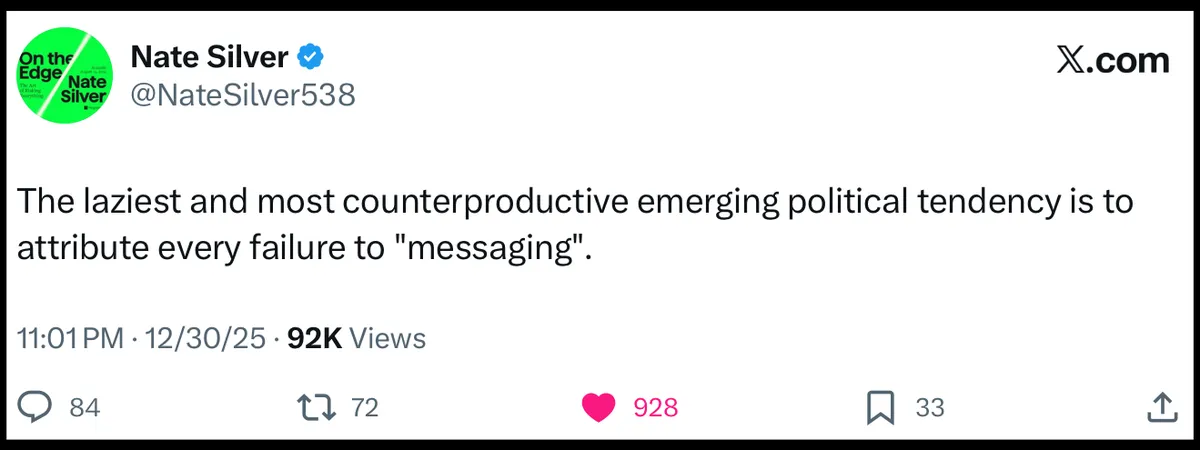
Agree and disagree. It’s definitely lazy and counterproductive.
But I’m mostly sure it’s not emergent, or at least I’m sure it’s not a new a wholly new thing. It’s extremely common in almost every form of politics, I suspect forever, but at least as long as I’ve observed them.
Both individual and group political actors tend to reach for messaging as the problem first, because it's easier than admitting you have a policy or coalition problem. You see this all the time with partisans on political social media, and it’s also a common lament of administrations.
At the individual level, people just don’t want to believe that their ideas aren’t fundamentally popular. They always think their cupboard is full of good policies that are also good politics. It's the first sin of the True Believer. If someone doesn’t like what you’re selling, it’s because they don’t understand it. So you just have to explain it better. Once everyone fully understands your tax / healthcare / immigration / economic plan, they’ll obviously support it. Some will be too stupid or too stubborn, but most people are good and good people who are informed will Agree With Me.
It’s nonsense, but it’s a lot easier than admitting in a democracy that people fully understand your policy but still don’t like it, because they have different legitimate values and preferences.
For groups—be it a party, a congressional caucus1, a presidential administration, or a political campaign—there’s a complicating problem beyond the fact that they are often composed of True Believers. Even if you are willing to admit that your problem might be deeper than messaging, it’s easy to talk yourself in trying a messaging fix first, because the other obvious strategy—policy adjustment—is a nightmare. All political groups are fragile coalitions of people with various interests, preferences, and agendas. To alter policy is to take the existing coalition and throw it into chaos.
That’s often necessary. But it’s hard work and creates lots of problems. So even if messaging is unlikely to be the solution, you might go with it on the long shot hope that it works, since blowing up your relationship with the environmentalist or the Tea Party or the women’s groups or the tax crusaders or anyone else is just a last resort. Dance with the one you brought and all that.
———————————-
There is a classic problem congressional parties have after they get clocked in an election. You tend to lose your members who are moderate, and so what’s left is more True Believers at exactly the wrong moment. And that often helps them learn the exact wrong lesson about policy vs. messaging.↩